
A brown ring spreading across the ceiling. A bubble of paint that looks like a blister. A slow drip into a pot you set out at midnight. Ceiling water damage in Toronto homes usually announces itself with a stain, and by the time you see it, water has been in the drywall and the cavity above for a while. A ceiling does a lot of harm per litre, because drywall holds water and the insulation above it soaks it up like a sponge.
The stain tells you less about the source than you would hope. Water travels along joists and pipes before it shows, so the mark can be a metre or more from the leak. Common causes in the GTA are a bathroom above with a failed seal at the tub or toilet, a pipe in the ceiling cavity, a roof leak, an ice dam in winter, a neighbour's unit upstairs in a condo, or condensation from poor attic ventilation. Finding the source matters, because drying the ceiling while the leak keeps running just means doing the job twice.
Look before you stand under it. Keep clear of any sagging or bulging section, since wet drywall is heavy and can drop without warning. If a bathroom is above, stop using it and shut off the supply to that fixture or the main water valve. If water is near a light fixture, switch off that circuit at the panel only if the panel is dry and safe to reach, otherwise stay away and leave the light off. Move furniture out from under the area and put a bucket in the drip zone.
A ceiling that is bulging with water can be relieved safely, and doing so often stops the whole panel from collapsing. Do it only when the sag is clearly full of water. Put a bucket or tub under the lowest point, wear safety glasses, stand to one side and not directly below, and poke a small hole with a screwdriver at the lowest point of the bulge. The water will run out in a stream. Make a few small holes rather than one big one. Never do this near a light fixture or where wires might be wet. In that case leave it alone and call us.
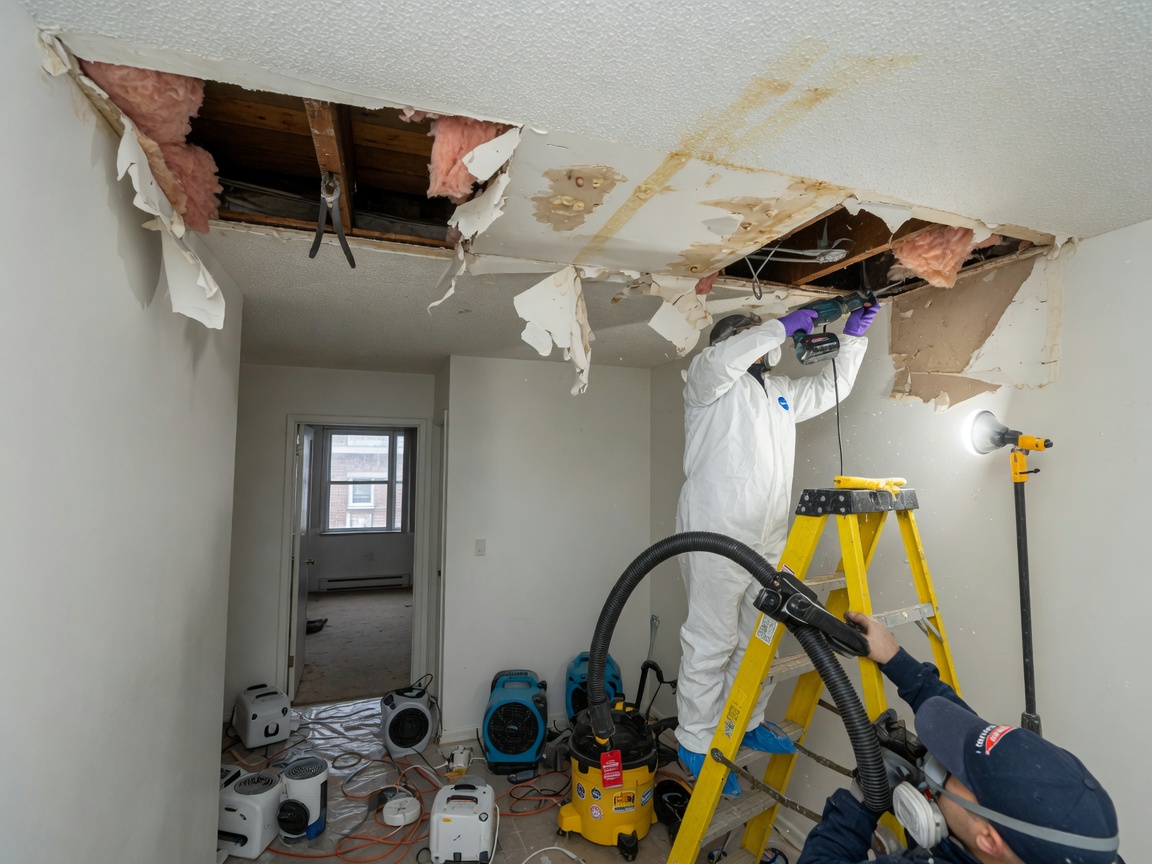
The job begins with finding how far the water went. A moisture meter and thermal camera show where the drywall, insulation and framing are wet, including beyond the stain. We remove sagging or soaked ceiling drywall and wet insulation, because a ceiling that has absorbed that much water rarely recovers. Then we set air movers and dehumidifiers, often with the cavity opened so air can reach the joists. Readings are logged daily until the framing is dry, and the opening is then ready for the ceiling to be closed up.
Ice dams are a Toronto winter problem. Heat escaping from the house melts snow on the roof, the meltwater runs to the cold eaves and refreezes, and the ridge of ice forces water back under the shingles and into the ceiling below. The stain tends to appear along an exterior wall or the edge of a ceiling during a thaw. A roofer or an attic insulation and ventilation contractor fixes the cause, and we dry what got wet. In a condo, a leak from the unit above is a matter for the condo corporation and the owners involved, and early photos help.
Ceiling jobs vary in cost for specific reasons. How much of the ceiling is wet. The ceiling height and access, such as a stairwell or a textured finish. Whether the insulation above is soaked. How many days of drying the space needs. How much drywall must come out. And whether water also ran down the walls. We explain the price on site before work starts, and we document photos and moisture readings for your home insurance claim.
Treat it as an emergency if the ceiling is sagging or bulging, if water is dripping steadily, if it is near a light or the electrical panel, or if the water is brown and smells foul, which can mean a drain line. A dry stain with no dampness is not urgent, but get a moisture check before you paint over it. A stain that comes back after painting almost always means the leak is still active or the cavity above is still wet.
From our crew: The visible stain is usually the smallest part of the wet area. Press a moisture meter on the ceiling a metre out in each direction, and check the wall below it. Water that has dripped inside a wall will not show on the ceiling at all.
After the ceiling comes the rest of the story. If water ran down the walls you may also need Drywall Water Damage Repair or Structural Drying, and if the leak started at a pipe, a plumber should repair it first. Call (226) 639-7972 if your ceiling is stained, sagging or dripping. We answer 24 hours a day, 7 days a week, across Toronto and the GTA, from Etobicoke and North York to Mississauga, Markham and Pickering.
Ceiling Water Damage Repair Services We Offer
✓Bulging Ceiling Drainage
Safe release of trapped water from a sagging ceiling before the panel gives way, with water caught and contained.
✓Wet Drywall and Insulation Removal
Soaked ceiling drywall and insulation are cut out so the joists and cavity can dry.
✓Ceiling Cavity Drying
Air movers and dehumidifiers dry the space above the ceiling, with readings logged daily.
✓Leak Source Tracing
We work out whether the water came from a bathroom, roof, ice dam or the unit above so the right trade is called.
How it works
- 1
Make it safe
We check for sagging, electrical risk and the water source, drain any water-filled bulge safely, and stop the supply if a pipe is the cause.
- 2
Find the wet area
Meter and thermal camera readings show how far moisture reached through the drywall, insulation and framing, beyond what the stain suggests. Where a ceiling meets an outside wall we check the wall too.
- 3
Open and dry
Soaked drywall and insulation come out, and air movers and dehumidifiers dry the cavity, with readings logged daily until the framing is dry. Dust and debris from the opening are kept under control.
- 4
Document and hand over
You get photos, readings and a plain account of the cause, and a plumber or roofer takes over for the source if needed. Photos are included for your home insurance claim.
Pricing
Cost depends on how much of the ceiling is wet, its height and access, whether insulation is soaked, how much drywall comes out and how many days of drying are needed. The price is explained on site before work starts.