
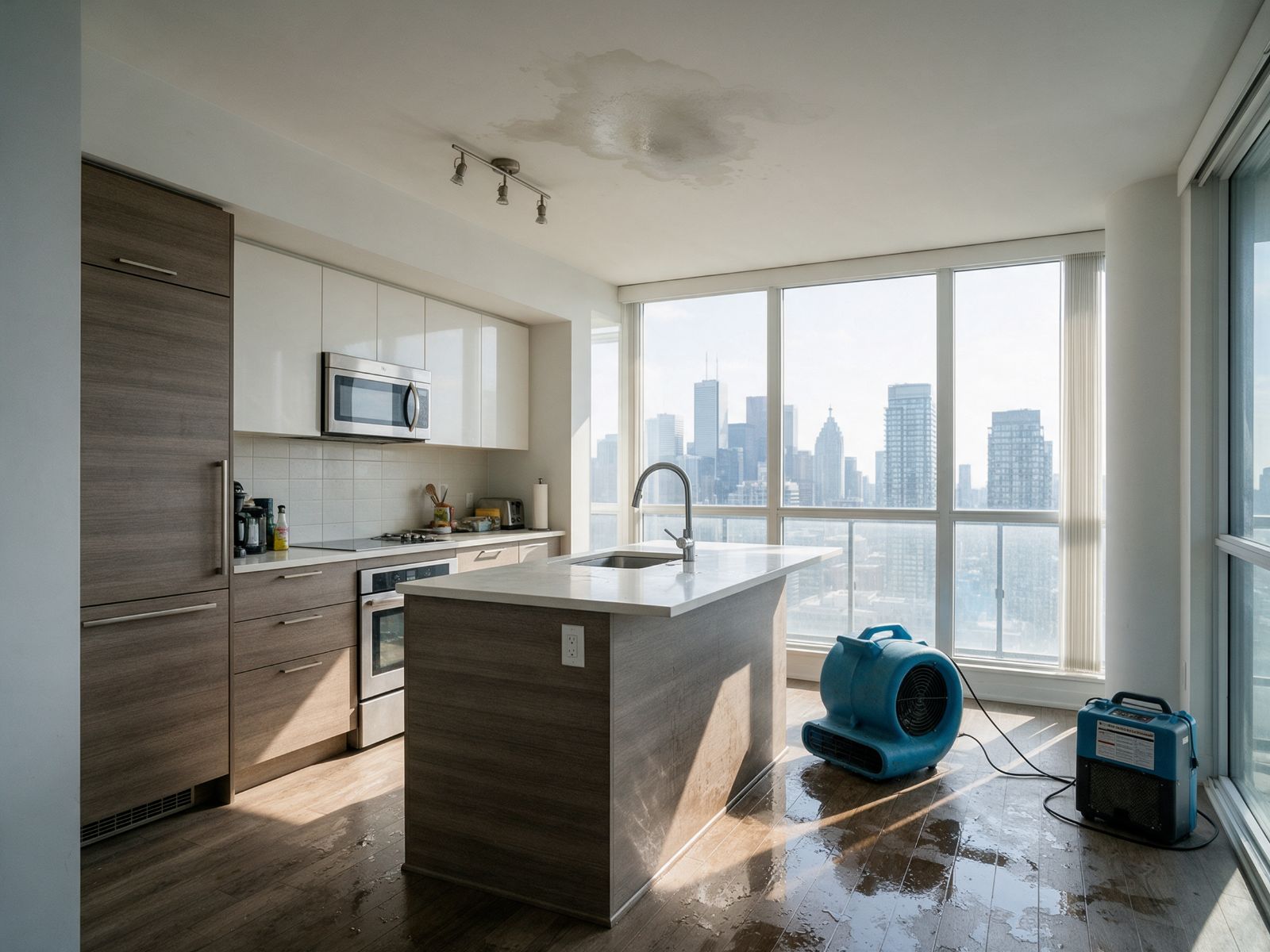
A drip appears at the corner of the bedroom ceiling. By the time you get a towel, the paint is bubbling and there is a brown ring spreading toward the light fixture. In a condo, the water is often not yours. It comes from the unit above, from a neighbour's washing machine hose, or from a pipe inside a shared wall, and you are left standing in your own living room with no idea whose problem it is or how far the water has gone.
Start with the water you can control. If you can see where it is coming from in your own unit, shut the unit's water supply, and if you cannot, call property management or the concierge right away so the building can shut the riser or send someone upstairs. Stay out from under a bulging ceiling, do not touch light fixtures that are wet, and switch off power to wet areas only if your panel is dry and safe to reach. Photograph everything before you move it.
Common causes are ordinary ones. A failed braided supply line behind a toilet, a washing machine hose that split, a dishwasher connection, an overflowing tub or a leaking shower pan upstairs will all send water through the floor slab seams, down walls and into the ceiling below. Some 1990s and 2000s buildings in the GTA also have Kitec plumbing, an orange and blue pipe system with brass fittings that has a known history of failing at the fittings. If your building has it, ask property management whether it has been replaced.
Who pays and who is responsible is a real question, and it sits outside what we can decide. Ontario condos work under the Condominium Act and the corporation's declaration, which sets out what counts as your unit and what is common property. Many corporations use the standard unit idea, where fixtures, finishes and improvements are the owner's but the original build is the corporation's. Read your declaration, or ask property management, because it affects which insurance policy responds. We are not lawyers, but we document the job so either insurer has what it needs.
That is why documentation matters more in a condo than in a house. We photograph the ceiling, walls and floor before anything is touched, record moisture meter readings in each room, and keep a written log of every day the equipment runs. You may be dealing with your own home insurance and the corporation's insurer, and sometimes the unit above's, so the readings and photos are written clearly enough to hand to each of them. We never promise what any insurer will decide.
The drying work follows the water. We extract standing water with portable extractors, because trucks cannot come up the elevator, then map the damage with a moisture meter and a thermal camera. Wet ceiling drywall is cut out, often in sections so the break is neat, and wet insulation, baseboards and flooring are removed or dried depending on the materials. Air movers and low-grain dehumidifiers run, and readings are logged until everything reaches dry standard. The shared wall or ceiling may hold water the neighbour's unit cannot see.
Working inside a tower has its own rules, and we plan around them. Most buildings book the freight elevator, restrict the hours for noise and for moving equipment, require protection on the floors and walls in hallways, and ask for contractor details at the front desk. Equipment that runs for several days also needs the unit's power, and fans and dehumidifiers make noise your neighbours will hear. We coordinate with property management so access is arranged before the equipment arrives.
The price depends on how many rooms are wet, what the materials are, how long the water ran, whether the water came from clean supply water or a drain, how many days the equipment runs, and what the building's access rules add. Smaller leaks caught early can be a short drying job, while a ceiling and floor soaked from a unit above is bigger. We explain the price on site before work starts. If the corporation or another unit is responsible, we keep your costs and records separate and clear.
Treat a condo leak as urgent if water is coming through the ceiling or light fixtures, if it has been running for hours, if the source is unknown or if more than one unit seems affected. Water travels along slab edges and through shafts, so a leak that starts on the 12th floor can show up in three units below, and delay lets materials soak and mould begin. In Toronto condos, a fast phone call to property management and a fast call to us both help.
From our crew: Take photos of the ceiling and the wall before you wipe anything, and send property management a written note the same day with the time you first saw water. In a condo, the date and the paper trail often count as much as the repair.
If your condo unit has water damage, call us at (226) 639-7972 at any hour, every day of the week. We work in condos across Toronto, from downtown towers to North York and Etobicoke, and across Mississauga, Vaughan, Markham and the rest of the GTA. We plan the elevator, the access and the drying, and keep the records ready for whoever has to see them. Have your unit number and the name of the building's property manager handy when you call.
Condo Water Damage Services We Offer
✓Leak From Above Response
Extraction and drying when water from a unit above comes through your ceiling, walls or light fixtures.
✓Appliance and Toilet Supply Line Damage
Drying after a dishwasher, washing machine or toilet supply line fails and floods the unit.
✓Kitec Plumbing Failure Damage
Extraction and drying where a Kitec fitting failure has soaked a wall or floor in an older tower.
✓Documentation for Insurers
Dated photos, moisture readings and daily logs prepared for your insurer and the corporation's.
How it works
- 1
Stop and notify
Water is shut off at the unit or by the building, property management is told, and we photograph and map the damage before anything is moved, cut or thrown away.
- 2
Plan the building
We book the elevator, agree working hours and protect the hallways, so the crew and equipment reach your unit without problems from the building's own access rules.
- 3
Extract and dry
Portable extractors remove water, wet ceiling and wall material is cut out where needed, and the drying equipment runs, with readings logged each day until dry standard.
- 4
Hand over records
You receive photos, readings and the daily log, written clearly so they can go to your insurer and, where it applies, to the condo corporation's insurer as well.
Pricing
Cost depends on how many rooms are wet, what the materials are, how long the water ran, how many days of drying equipment are needed and what building access rules add. The price is explained on site before work starts.